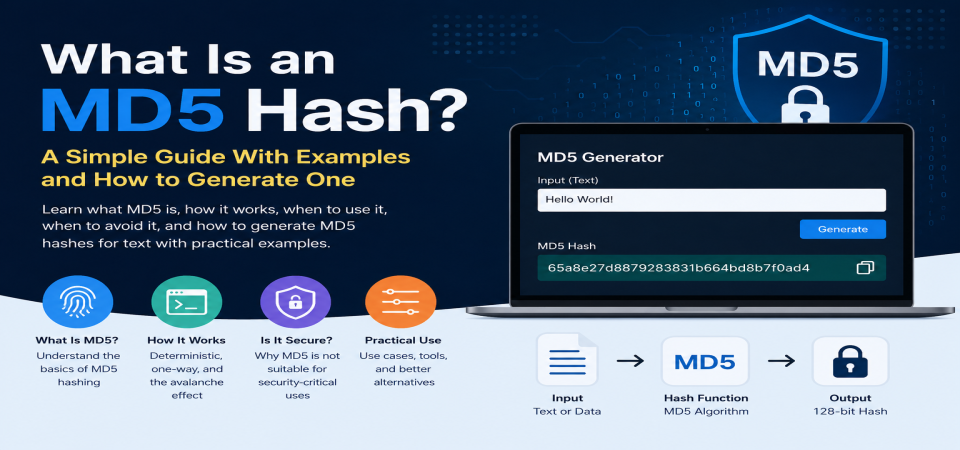
What Is an MD5 Hash? A Simple Guide With Examples and How to Generate One
If you have ever downloaded a file and seen a long string of letters and numbers labeled MD5, or been asked to verify an MD5 checksum, you have encountered a hash value.
MD5 is one of the best-known hash functions in computing. It is still found in legacy systems, file verification workflows, development tools, and other situations where a quick and consistent data fingerprint is useful.
But what exactly is an MD5 hash? Is MD5 encryption? Is it still secure? And when should you use it?
This guide explains how MD5 works, shows practical examples, and explains why it should not be used for security-sensitive applications.
What Is MD5?
MD5 stands for Message-Digest Algorithm 5. It is a cryptographic hash function that converts input data into a fixed-length value called a hash or digest.
It is important to understand that hashing and encryption are not the same thing.
Encryption is designed to be reversible. Data is transformed using an encryption algorithm and a key, allowing someone with the appropriate key to decrypt it.
Hashing, on the other hand, produces a fixed-length result from an input. A hash function does not provide a normal decryption process that allows you to recover the original input from the hash.
MD5 produces a 128-bit digest, normally represented as a 32-character hexadecimal string.
For example, the MD5 hash of:
hellois:
5d41402abc4b2a76b9719d911017c592Whether the input is a short text string or a much larger amount of data, the resulting MD5 digest remains 128 bits long.
How Does MD5 Work?
You do not need to understand the mathematical details behind MD5 to understand its most important properties.
The Same Input Produces the Same Hash
MD5 is deterministic. If you calculate the MD5 hash of exactly the same input multiple times, you will get the same result.
For example, the word:
hellowill always produce:
5d41402abc4b2a76b9719d911017c592provided the input is exactly the same.
A different letter, space, or character encoding can result in a different hash.
Small Changes Can Produce a Completely Different Hash
Changing even one character can significantly change the resulting hash.
For example:
Helloproduces:
8b1a9953c4611296a827abf8c47804d7while:
helloproduces:
5d41402abc4b2a76b9719d911017c592The only visible difference is the capitalization of the first letter, yet the two hashes are completely different.
This behavior is one reason hash functions are useful for comparing data.
How to Generate an MD5 Hash
If you need to generate an MD5 hash from text, you can use the MD5 Generator on ChefNova.
The basic process is straightforward:
- Open the MD5 Generator.
- Enter the text you want to hash.
- Generate the MD5 hash.
- Copy the resulting value.
- Compare or store the hash wherever it is needed.
For accurate results, make sure the input is exactly what you intend to hash. A trailing space, different capitalization, or another small change can produce a different result.
Try a Simple Example
Enter:
Helloand generate its MD5 hash.
Then change the input to:
helloGenerate the hash again and compare the two values.
This simple experiment demonstrates how a small change in the input can produce a completely different output.
Is MD5 Secure?
This is one of the most important questions about MD5.
The short answer is no, MD5 should not be used for security-sensitive applications.
Researchers have demonstrated practical collision attacks against MD5. A collision occurs when two different inputs are deliberately constructed to produce the same hash.
This is a serious weakness when an attacker may be able to manipulate data and attempt to make a malicious file or message appear to have the same hash as a legitimate one.
For that reason, MD5 should not be relied on for applications that require strong collision resistance.
It is especially inappropriate for:
- Digital signatures
- Certificate validation
- Security-sensitive integrity verification
- Password storage
- Systems where an attacker can deliberately manipulate the input
Can MD5 Be Used for Passwords?
No.
MD5 is not an appropriate password-hashing algorithm.
One of the main problems is that MD5 is extremely fast. While speed can be useful when calculating checksums, it is undesirable when protecting passwords because attackers can test enormous numbers of password guesses quickly.
Another problem is that MD5 was not designed specifically for password storage and does not provide the protections expected from a modern password-hashing scheme.
Modern applications should use password-hashing algorithms specifically designed for this purpose, such as:
- Argon2
- bcrypt
- scrypt
These algorithms are designed to make large-scale password guessing substantially more difficult.
It is also important to note that SHA-256 should not simply replace MD5 for password storage. SHA-256 is a stronger general-purpose hash function, but it is still designed to be fast. Password storage requires a dedicated password-hashing approach.
MD5 vs. SHA-256
MD5 and SHA-256 are both hash functions, but they have very different security properties.
| Feature | MD5 | SHA-256 |
|---|---|---|
| Digest length | 128 bits | 256 bits |
| Hexadecimal representation | 32 characters | 64 characters |
| Collision resistance | Broken | No practical collision attack is currently known |
| Suitable for modern security applications | No | Yes, where appropriate |
| Suitable for password storage | No | No — use a dedicated password-hashing algorithm |
SHA-256 is therefore a much better choice than MD5 when a modern cryptographic hash is required.
However, the choice between MD5 and SHA-256 depends on the actual purpose. Neither algorithm should be treated as a password-storage solution.
When Is MD5 Still Useful?
Although MD5 is no longer considered suitable for security-critical applications, there are still situations where you may encounter or use it.
Legacy Systems
Older applications, databases, scripts, and APIs may still use MD5 because they were designed around it.
Replacing MD5 in such systems may require changes to existing software or data structures.
Basic File Comparisons
MD5 can still be encountered when checking whether two files produce the same hash in a non-adversarial situation.
For example, if you download a file and a trusted source provides an MD5 checksum, comparing the two values can help detect accidental corruption or an incomplete transfer.
However, MD5 should not be relied upon when an attacker could deliberately create a different file with the same MD5 hash.
Learning and Testing
MD5 is also useful for learning how hash functions behave.
Generating hashes from different inputs is a simple way to understand concepts such as deterministic output and the effect of changing input data.
When Should You Avoid MD5?
You should avoid MD5 whenever strong security properties are required.
This includes:
- Storing passwords
- Digital signatures
- Certificate validation
- Security-sensitive authentication systems
- Applications where an attacker may deliberately manipulate data
- Any system that requires strong collision resistance
In these situations, choose an algorithm designed for the specific security requirement instead of relying on MD5.
MD5 and File Integrity: An Important Distinction
You may still see MD5 checksums published alongside downloadable files.
A checksum comparison can be useful for detecting accidental changes or corruption, but there is an important limitation.
Because practical MD5 collisions exist, an MD5 value should not be treated as proof that a file came from a trusted source when an attacker could influence both the file and its checksum.
In security-sensitive situations, a modern cryptographic hash and an appropriate authentication or signature mechanism should be preferred.
Frequently Asked Questions About MD5
What is an MD5 hash?
An MD5 hash is the 128-bit output produced by the MD5 hashing algorithm. It is normally displayed as a 32-character hexadecimal string.
Is MD5 encryption?
No. MD5 is a hash function, not an encryption algorithm. Hashing and encryption serve different purposes.
Can an MD5 hash be decrypted?
There is no normal decryption operation for an MD5 hash. However, if the original input is common or predictable, it may be possible to discover it through guessing, dictionaries, or precomputed data.
Is MD5 secure?
MD5 is not considered secure for applications that require collision resistance or other modern cryptographic security properties.
Can I use MD5 to store passwords?
No. MD5 is too fast and was not designed for password storage. Use a dedicated password-hashing algorithm such as Argon2, bcrypt, or scrypt instead.
What is the difference between MD5 and SHA-256?
MD5 produces a 128-bit hash, while SHA-256 produces a 256-bit hash. MD5 has known practical collision attacks, whereas SHA-256 currently has no known practical collision attack. Neither should be used directly for password storage.
Does the same text always produce the same MD5 hash?
Yes. MD5 is deterministic, so identical input produces identical output.
How long is an MD5 hash?
An MD5 digest is 128 bits long and is normally represented by 32 hexadecimal characters.
Conclusion
MD5 is a well-known hashing algorithm that converts input data into a fixed 128-bit digest. Its deterministic behavior and simplicity explain why it remains visible in older software, legacy systems, and some basic checksum workflows.
However, MD5 is no longer appropriate for security-sensitive applications because practical collision attacks have been demonstrated. It should also never be used as a password-storage algorithm.
If you simply need to generate an MD5 hash from text and understand how the algorithm behaves, you can try the MD5 Generator on ChefNova.
For modern security applications, choose a cryptographic algorithm appropriate for the specific task rather than assuming that every hashing algorithm provides the same level of protection.
References
- RFC 1321 — The MD5 Message-Digest Algorithm, Internet Engineering Task Force (IETF)
- NIST FIPS 180-4 — Secure Hash Standard (SHS)
- OWASP — Password Storage Cheat Sheet