What Is a Plagiarism Checker? How It Works and How to Check Your Content
Publishing or submitting content that is too similar to someone else's work can create serious problems for students, writers, publishers, and website owners. Sometimes the issue is obvious because text was copied directly. In other cases, a writer may unintentionally use wording that is too close to a source.
A plagiarism checker can help identify these similarities before content is submitted or published. But it is important to understand what these tools actually measure.
A similarity result is not automatically proof of plagiarism. Context, attribution, quotations, and the source of the matching text all matter.
In this guide, we'll explain what plagiarism is, how plagiarism checkers work, how to interpret their results, and how to review your writing before publishing it.
What Is Plagiarism?
Plagiarism generally means presenting someone else's words, ideas, or work as your own without appropriate acknowledgment.
The exact rules can vary between schools, universities, publishers, employers, and other organizations. However, several forms of plagiarism are commonly recognized.
Direct Plagiarism
Direct plagiarism occurs when someone copies another person's wording without properly identifying it as a quotation or providing appropriate attribution.
For example, copying a paragraph from an article and presenting it as your own writing would generally be considered direct plagiarism.
Paraphrasing Plagiarism
Paraphrasing does not simply mean replacing a few words with synonyms.
If the original sentence structure and wording remain too similar while the source is not properly acknowledged, the result may still be considered plagiarism.
A genuine paraphrase should be written in your own language and should still give appropriate credit to the original source when the underlying idea or information comes from that source.
Mosaic Plagiarism
Mosaic plagiarism involves combining copied words, phrases, or structures from one or more sources into new writing without appropriate attribution.
The result may look different from the original material while still relying too heavily on the source wording.
Self-Plagiarism
Self-plagiarism refers to reusing substantial portions of your own previously submitted or published work in a situation where new or original work is expected.
Whether this is considered a violation depends on the context and the rules of the relevant institution or publisher.
What Is a Plagiarism Checker?
A plagiarism checker is a tool that looks for similarities between submitted text and content available in the sources or databases it can compare against.
Depending on the tool, a plagiarism check may identify matching words, phrases, or passages and present them in a report.
This can be useful when reviewing an article, essay, research assignment, or other written material before submission or publication.
However, a plagiarism checker does not normally determine a writer's intent.
It identifies textual similarity. Deciding whether that similarity represents plagiarism requires context.
For example, a properly quoted passage may be highlighted as a match even though the writer has correctly attributed it.
How Does a Plagiarism Checker Work?
The exact technology differs between plagiarism-checking services, but the general process is relatively straightforward.
1. Text Is Submitted for Analysis
The text you want to review is provided to the plagiarism checker.
Depending on the service, this may involve pasting text into a text field or submitting content through another supported method.
2. The Text Is Compared With Available Sources
The checker analyzes the submitted text and looks for similarities against the material available to its comparison system.
This could include indexed web pages, documents, publications, or other sources depending on the service.
No plagiarism checker should be assumed to have access to every piece of content that exists online.
3. Potential Matches Are Identified
When similar wording is found, the system may identify the matching passage and provide information about the potential source.
The exact format of the report depends on the tool.
4. The Results Are Reviewed
This is the most important step.
A writer should examine the highlighted passages and determine why the similarity exists.
A match might be:
- An unattributed copied passage
- A properly quoted section
- A common phrase
- A factual statement that naturally appears in similar wording
- A passage that needs better paraphrasing or attribution
The report is therefore a starting point for review, not a final judgment.
What Can a Plagiarism Checker Detect?
A plagiarism checker can be useful for finding several types of textual similarity.
Exact Matches
These are passages where the submitted wording closely matches wording found in another source.
Long, distinctive matches deserve particular attention.
Very Similar Wording
A checker may also identify passages that are not identical but remain unusually close to another source.
This can help writers recognize paraphrasing that has not gone far enough.
Reused Passages
If previously published or accessible material is included in the comparison sources, reused passages may be identified.
However, the ability to find previously published content depends on the sources available to the particular checker.
Common Language
Not every match is meaningful.
Technical terms, standard expressions, titles, names, and commonly used phrases can naturally appear in many documents.
This is one reason a report should always be reviewed rather than treated as an automatic verdict.
What a Plagiarism Checker Cannot Reliably Prove
A plagiarism checker can identify similarities, but it generally cannot determine why those similarities exist.
For example, a matching passage may appear because:
- The writer copied it without attribution.
- The passage is a properly cited quotation.
- The wording is a common expression.
- The subject requires specific terminology.
- The writer used a source correctly but the checker does not understand the context.
- The source contains information that is commonly described using similar wording.
This distinction is important because similarity is not the same thing as plagiarism.
A percentage shown by a checker should therefore be treated as an indicator for further review rather than an automatic judgment about the quality or integrity of the writing.
Types of Content Similarity
Not every similarity needs to be handled in the same way.
Consider a simple example.
Suppose a source says:
"Water freezes at 0°C under standard atmospheric pressure."
A writer may need to communicate the same scientific fact. Some similarity in meaning is unavoidable because the underlying fact does not change.
However, copying a distinctive explanation or paragraph from the source without attribution is a different situation.
The goal is not to make every sentence look completely different from every source. The goal is to write independently, use sources responsibly, and provide appropriate attribution when information or wording comes from elsewhere.
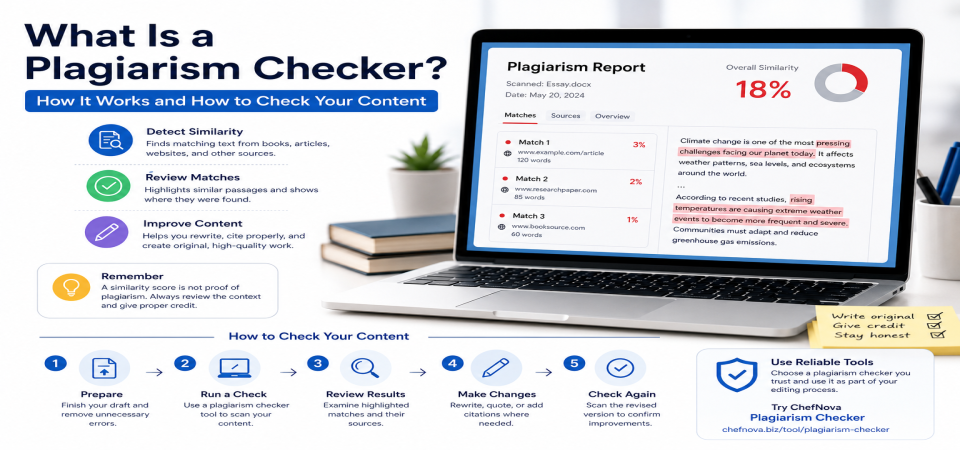
How to Check Content for Plagiarism
A plagiarism check is most useful when it is part of a broader editing process.
A practical workflow looks like this:
Step 1: Prepare Your Content
Finish a reasonable draft before checking it.
Review obvious grammar, formatting, and citation issues first.
Step 2: Run the Text Through a Plagiarism Checker
Use a plagiarism-checking tool to identify potential similarities.
You can use the ChefNova Plagiarism Checker as part of this review process.
Only rely on features that the tool actually provides.
Step 3: Review the Highlighted Matches
Do not focus only on the final percentage.
Look at the actual passages that were identified and examine their sources where available.
Step 4: Decide Why Each Match Exists
Ask:
- Is this a quotation?
- Is the source properly credited?
- Is the phrase common?
- Is the wording unnecessarily close to the source?
- Does the passage need to be rewritten?
Step 5: Make Necessary Changes
If you copied wording without attribution, either quote and attribute it appropriately or rewrite the passage in your own words while still crediting the source when required.
Do not simply replace a few words with synonyms.
Step 6: Check the Revised Version
For important documents, checking the revised version again can help confirm that obvious similarities have been addressed.
How to Interpret a Plagiarism or Similarity Result
One of the biggest mistakes people make is treating a plagiarism percentage as a universal pass-or-fail score.
There is no single percentage that automatically determines whether content is acceptable in every situation.
A report showing some similarity does not necessarily mean the content contains plagiarism.
For example, a document might contain:
- Properly cited quotations
- References and bibliography entries
- Names and technical terms
- Common phrases
- Standard definitions
These can contribute to similarity without representing dishonest copying.
Likewise, a low similarity result does not automatically prove that every part of a document is original or properly attributed.
The most useful part of a plagiarism report is often the specific matching passages and their sources, not the headline percentage alone.
How to Avoid Accidental Plagiarism
Good research habits can prevent many plagiarism problems before they appear in a checker.
Keep Track of Your Sources
When researching, record where important facts, quotations, and ideas came from.
This makes it much easier to add accurate citations later.
Separate Notes From Quotations
When taking research notes, make it clear which text is copied directly from a source and which notes are your own.
This reduces the chance of accidentally treating copied wording as original writing.
Write From Understanding
Instead of keeping the source open and changing words sentence by sentence, read the material, understand the idea, and then explain it independently.
This generally produces clearer and more natural writing.
Cite When Appropriate
If an idea, quotation, statistic, research finding, or other information requires attribution in your context, provide it.
The exact citation style depends on the requirements of your school, publisher, organization, or field.
Do Not Try to "Beat" the Checker
The goal should not be to manipulate text until a particular tool reports zero matches.
A document can contain legitimate similarities, and a low score does not automatically make the writing high quality.
The better goal is to create genuinely original writing while using sources responsibly.
Plagiarism Checker vs. AI Detector
Plagiarism checkers and AI detectors are designed to address different questions.
A plagiarism checker generally looks for similarities between submitted text and material in the sources available to its comparison system.
An AI detector attempts to estimate whether text may have been generated by an artificial intelligence system.
These are not the same thing.
A plagiarism checker finding no match does not prove that a text was written by a human.
Likewise, an AI detector producing a particular result does not by itself establish that a person committed plagiarism.
If you are reviewing content, use the appropriate tool for the question you are trying to answer.
Common Mistakes When Using Plagiarism Checkers
Treating Every Match as Plagiarism
A highlighted match requires examination. It is not automatically evidence of wrongdoing.
Focusing Only on the Percentage
The number can be useful as a general signal, but the individual matches provide more context.
Ignoring the Source
Always examine where a similarity comes from when the information is available.
Changing a Few Words and Calling It Original
Replacing individual words while keeping the original sentence structure too closely can still create an attribution problem.
Assuming a Clean Result Means Perfect Content
A plagiarism checker is only one part of the editing process.
A document can have no obvious matches and still contain factual errors, weak writing, poor citations, or unsupported claims.
Forgetting About Proper Attribution
The goal is not simply to avoid matching text. Writers also need to acknowledge sources when their work requires it.
Frequently Asked Questions
What is a plagiarism checker?
A plagiarism checker is a tool that compares submitted text with available sources to identify potentially similar or matching passages.
How does plagiarism detection work?
Most plagiarism checkers analyze submitted text and compare it with content available in their comparison sources. They may then highlight similar passages and identify possible sources.
The exact process varies between tools.
Is a plagiarism score proof of plagiarism?
No. A similarity score is not, by itself, proof of plagiarism. Individual matches need to be examined in context.
Can plagiarism checkers detect paraphrasing?
Some checkers can identify wording that is very similar to a source even when it is not copied word for word. However, detection capabilities vary, and no checker should be assumed to identify every form of paraphrasing.
Can a plagiarism checker detect everything copied from the internet?
No checker should be assumed to detect everything published online. Results depend on the sources available to the particular service.
Is self-plagiarism still plagiarism?
Self-plagiarism generally refers to reusing previously submitted or published work without appropriate disclosure when original work is expected. Whether it violates a particular policy depends on the context.
What is the difference between plagiarism checking and AI detection?
Plagiarism checking focuses primarily on textual similarity with available sources. AI detection attempts to estimate whether text may have been generated by an AI system. They address different questions.
How can I check my article for plagiarism?
Run the article through a plagiarism checker, review the matching passages and sources, determine whether each match is legitimate, and revise or attribute material where necessary.
Can properly cited content still appear as a match?
Yes. A properly quoted or cited passage can still be identified as similar because the wording matches the source. This is why context and attribution matter when interpreting a report.
Conclusion
A plagiarism checker is a useful tool for reviewing written content before publication, submission, or sharing. It can help identify passages that resemble material in its available comparison sources and give writers an opportunity to investigate those matches.
But a similarity report should not be treated as an automatic verdict.
A responsible review involves looking at the actual matching passages, checking their sources, understanding why the similarity exists, and making sure quotations and attributions are handled appropriately.
If you want to review your writing for potential similarities, you can use the ChefNova Plagiarism Checker as part of your editing workflow.
The ultimate goal is not simply to obtain a low similarity percentage. It is to produce clear, original writing while using other people's work responsibly.
References
- Purdue Online Writing Lab (Purdue OWL) — resources on plagiarism, paraphrasing, and avoiding plagiarism.
- University academic integrity guidance — policies and educational resources on plagiarism and proper attribution.